
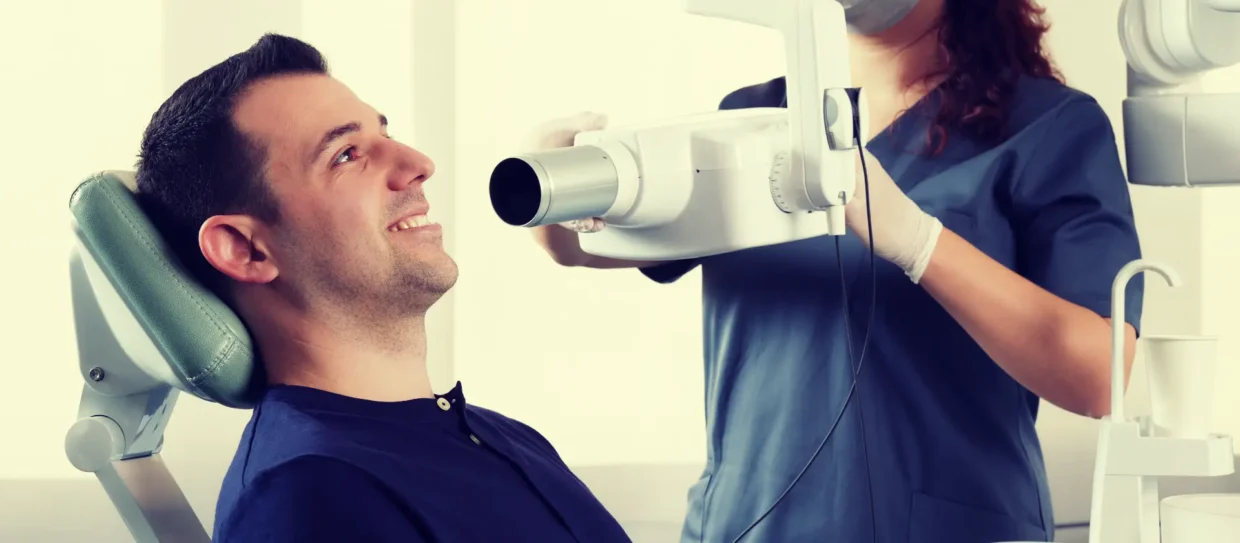
Purchasing dental X-ray equipment can be challenging. With so many products out there, it’s often difficult to know exactly what you need, especially when it comes to digital sensors, CBCT, and panoramic systems.
Fortunately, this guide is here to help. We run through some of the products currently on the market, explaining what each of them does and how you can implement them in your practice. Here’s everything you need to know:
Start with diagnoses and work out what your charts require
The first step is to start with diagnoses and what your charts require. Don’t just look at a spec sheet and assume the hardware has everything you need. Consider how you actually use the items that you acquire in your practice. For example:
- If you do routine restorative endo, perio, and bite wings, then you’ll probably need an intraoral centre of some kind. These pieces of equipment cover the vast majority of this work, and patients love it because they don’t have to use gag-inducing molds.
- If you work more on third molars, TMJ, sinuses, ortho-assessments, full arch overviews, and so on, then you’ll probably need a panoramic unit.
- If you perform implant placements, airway studies, or complex oral surgery, then you’ll need some sort of cone beam CT (CBCT).
Check how many cases leave your practice each month for 3D imaging elsewhere. If there’s more than a handful, that gives you a strong case for biting the bullet and purchasing a cone beam. If that’s not the case, then a pano plus good sensors will usually serve you well.
Intraoral digital sensors: a modern clinic’s workhorse
Intraoral digital sensors are the workhorses of clinics in 2026. They’re often used dozens of times a day, dropped, bitten, disinfected, and then the cycle repeats. Fortunately, many manufacturers make these products with durability and quality in mind, so they can last a long time.
The Carestream RVG 6200 Size 2 is a good example of this in practice. It provides clinically useful images with fine-tuning exposure for every patient and dose indicator flags for over- or underexposure to correct settings quickly.
What’s particularly attractive about this unit is its CS-Adapt module. This adds various functionality, including:
- 40 preset enhancement filters
- Various endodontic, periodontic, and dentin enamel junction anatomical modes
- A sharpness slider which can be saved with a custom default
If you’re looking for a smaller unit for pediatric patients, then you might want to opt for the RVG 6200 Size 1. This features narrower construction, making it easier to put into children’s mouths and take images of all interior surfaces. It’s also great for patients who have strong gag reflexes or shallow palates. If you want to be on the safe side, get this product in both size 1 and 2.
Finally, a note on cable design: the RVG 6200’s rear cable is 20% thinner than previous models, and all sensors are now fully waterproof, enabling full submersion in septic solutions.
Panoramic systems for whole-jaw views
The Planmeca ProMax 2D S3 is a panoramic system built for whole-jaw views. It’s useful for TMJ patients, including:
- Sinus imaging
- Cephalometric and panoramic shots
- Extraoral bite wing shots
It has an autofocus feature that positions the focal layer using a low-dose scout image of the central incisors. This approach cuts retakes and reduces radiation exposure. It also comes with dynamic exposure control, which can adjust exposure levels according to patients’ bone density and anatomy. Before ordering an extraoral unit to measure the room, the ProMax 2D S3 needs 150cm of height by 163cm of depth by 215 cm of width, with extra room needed for the operational footprint of the cephalostat.
CBCT for 3D imaging
In cases where 2D sensors and X-rays simply won’t work, you need full-scale 3D imaging. That’s where the Carestream CS 9300 can help. This piece of equipment combines multiple capabilities, including the main cone beam 3D sensor, upgradeable one-shot cephalometrics, and a dedicated 2D panoramic sensor.
Clinics love this device because it has a huge field of view and flexibility. This is what separates this particular CBCT from inexpensive options on the market.
The device’s measurement range can span 5 cm by 5 cm up to 17 cm by 13.5 cm, enabling dentists to capture single implant sites at high resolutions of up to 90 µm. It’s also useful for complete maxillofacial exams and low-dose capture modes that are sometimes able to bring 3D radiation scan levels down to 2D panoramic.
If you buy the product, you also get other benefits bundled with it, including storage and sharing, analysis options, and TWAIN integration. The latter capability can drop panoramic images into most standard clinical platforms like Schick, Eaglesoft, and Dolphin.
Budgeting beyond the sticker price
What you pay depends on the tier of equipment you need. Intraoral sensors start at around $1,800 each, while panoramic units cost $15,500 each. If you’re looking for a combined CBCT, pano, and ceph system, that would be nearer to $18,000.
In general, certified pre-owned equipment is often best. It provides high-quality imaging while also being more affordable for clinics on a budget. Refurbished systems often come with installation, training, parts, and a service warranty, delivering the same clinical capabilities as if you’d bought brand new.
The downside is that you may not get access to the very latest technology, but whether you need this depends on the type of work that you do at your practice. If you mainly perform simple work or don’t have any requirements for the latest equipment, then refurbished tools may be sufficient. Furthermore, many refurbished tools are actually brand-new pieces of equipment, perhaps display models or equipment with minor scratches and scuffs.
Buy modular
Finally, if you are looking for the smartest way to shop, buy modular equipment. For example, the Pro Max 2D S3 is upgradable from 2D to 3D and can be equipped with a cephalometric arm later.
Browse the full dental X-ray range to compare systems.